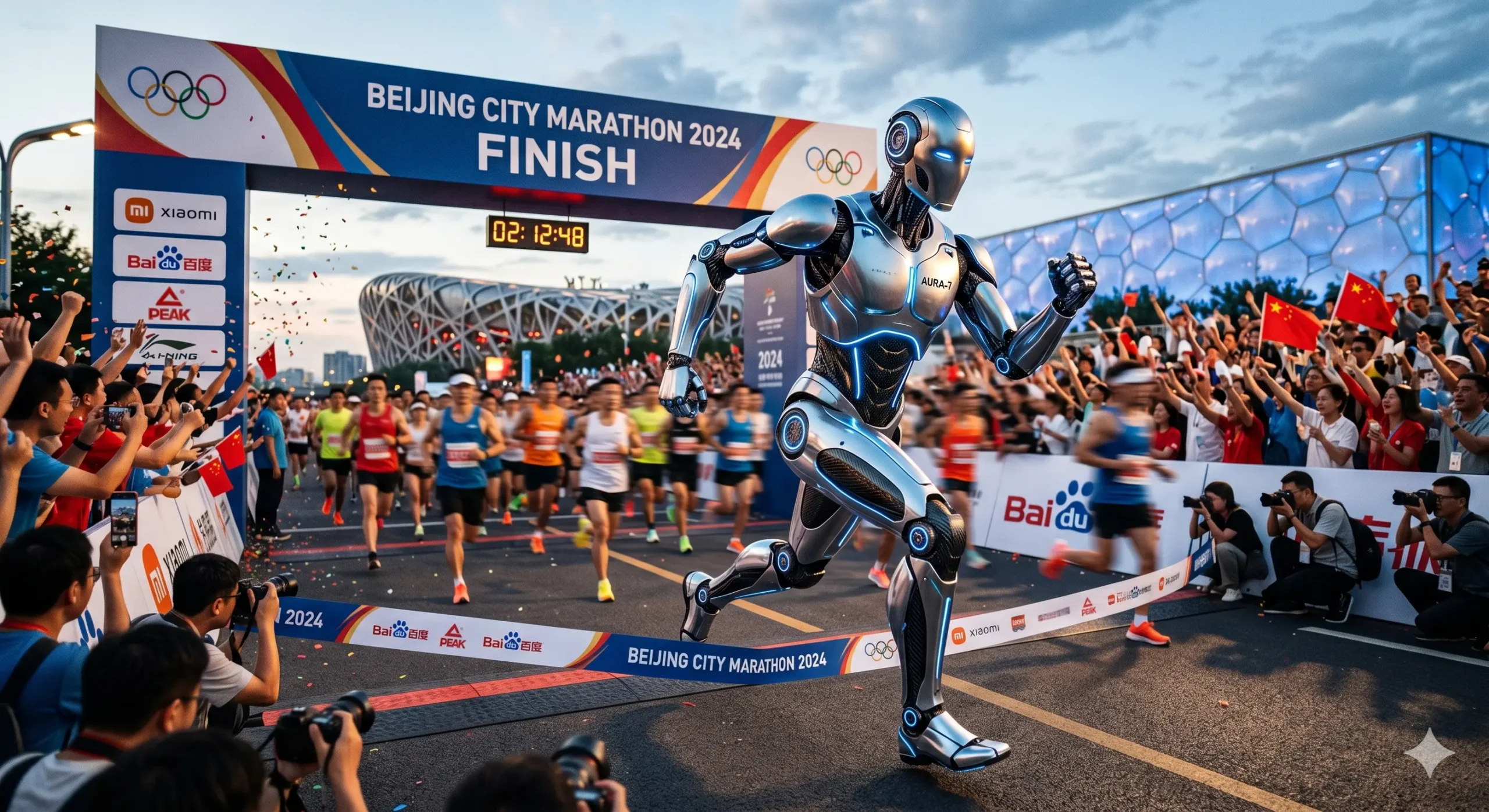
In a historic milestone for robotics and AI, a bipedal humanoid robot has officially broken the human half-marathon world record in Beijing. Read about the tech behind the speed
BEIJING, CHINA — In a stunning display of mechanical engineering and artificial intelligence, a fully autonomous humanoid robot sprinted to victory this week, officially breaking the human world record for a half-marathon. The historic event, which took place on the streets of Beijing on April 16, 2026, marks a massive leap forward in bipedal robotics, proving that machines can now match—and exceed—elite human endurance and agility.
The robot, developed by a consortium of leading Asian tech firms, completed the 13.1-mile (21.09 km) course in a time that left both tech enthusiasts and sports scientists in awe, sparking global conversations about the future of physical AI.
The Technology Behind the Speed
Running a marathon requires more than just powerful motors; it demands real-time spatial awareness, energy conservation, and flawless dynamic balance. The engineering team attributed the robot’s success to two major breakthroughs in tech:
- Advanced Gyroscopic Stabilization: The robot utilizes a next-generation neural network that processes terrain data in milliseconds. This allows it to adjust its stride, posture, and weight distribution instantly, mimicking the natural micro-adjustments of a human athlete.
- Solid-State Battery Efficiency: To sustain high-speed performance without overheating or running out of power, the bot was equipped with newly developed lightweight solid-state batteries, drastically improving its energy-to-weight ratio.
AI Navigation in Real-World Environments
Unlike controlled laboratory tests, the Beijing half-marathon required the AI to navigate unpredictable real-world variables. The robot successfully used LiDAR and advanced computer vision to avoid potholes, navigate around human competitors safely, and adjust its pace based on wind resistance and incline.
A New Era for Athletics and Robotics?
While the robot’s participation was technically an exhibition and does not impact official human athletic standings, the implications for the tech industry are profound.
Experts note that the same bipedal stabilization and battery technologies used to win the marathon are already being adapted for search and rescue operations, hazardous industrial work, and advanced prosthetics for amputees.
Summary of Major Takeaways
- Historic Milestone: A humanoid robot successfully completes a half-marathon in Beijing, beating the fastest recorded human times.
- Advanced Tech: The achievement was made possible by new solid-state battery technology and AI-driven dynamic balancing.
- Real-World Navigation: The robot autonomously navigated a complex urban environment, safely avoiding human runners and obstacles.
- Future Applications: The underlying technology is expected to revolutionize search and rescue, industrial labor, and medical prosthetics.
As the line between biological limits and mechanical capability continues to blur in 2026, the tech world watches eagerly to see where these autonomous machines will run next.