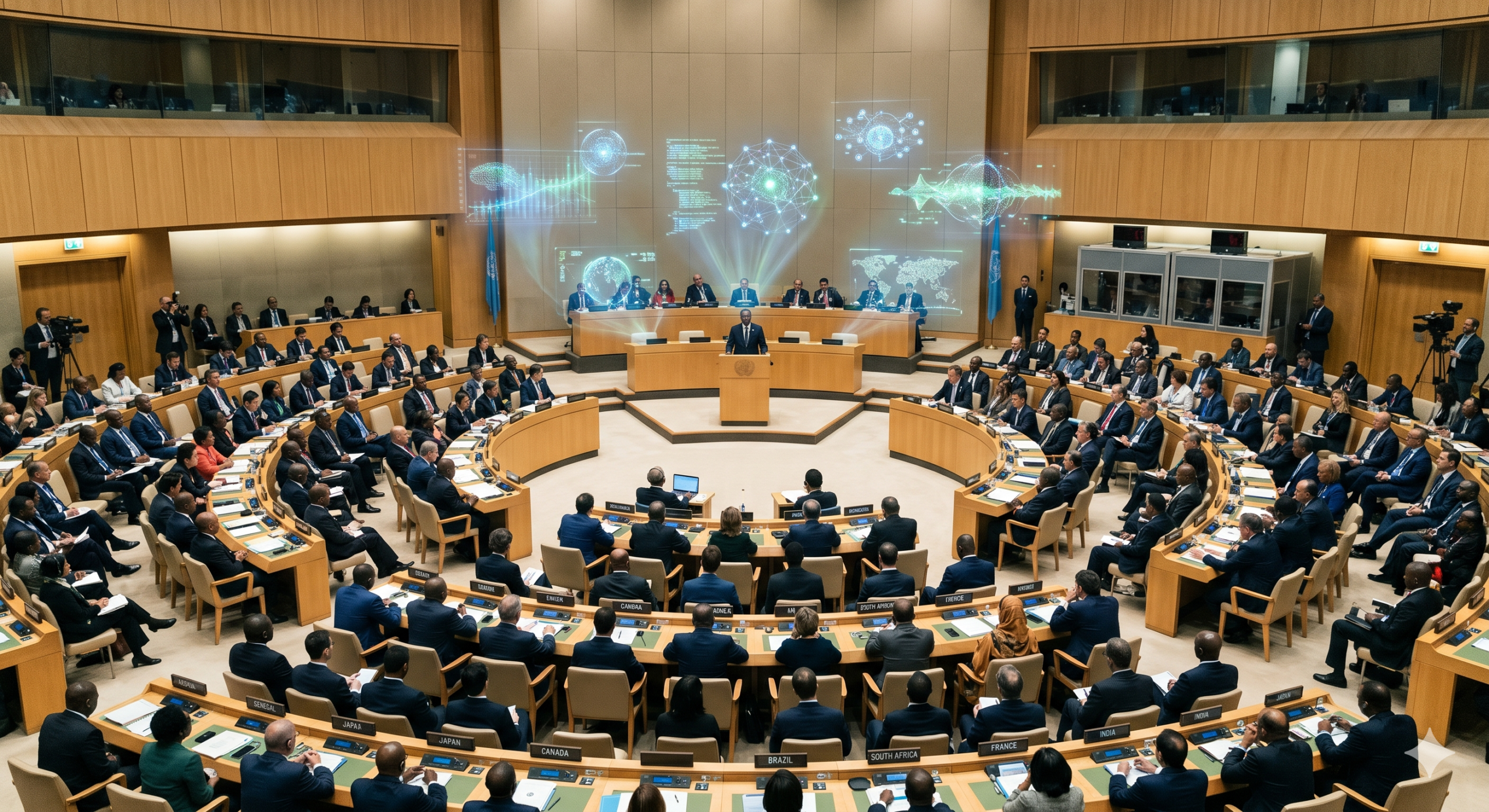
In a landmark decision, the UN has officially ratified the 2026 Global AI Governance Treaty in Geneva. Discover how this new international law will regulate AI safety, deepfakes, and global tech development.
GENEVA, SWITZERLAND — In an unprecedented display of international cooperation, member states of the United Nations officially ratified the Global Artificial Intelligence Governance Treaty early this morning. The landmark agreement, finalized after nearly three years of intense negotiations, establishes the world’s first comprehensive, legally binding international framework for the safe development, deployment, and regulation of Artificial Intelligence.
The treaty aims to balance the rapid acceleration of AI technologies with critical ethical considerations, ensuring that future digital advancements do not compromise global security or human rights.
Key Provisions of the Historic Treaty
The comprehensive document outlines strict parameters for tech companies and governments worldwide. It specifically targets the most high-risk applications of machine learning and generative algorithms.
- Strict Ban on Autonomous Weaponry: The treaty outright prohibits the development and deployment of lethal autonomous weapons systems (LAWS) that operate entirely without human oversight.
- Deepfake and Misinformation Accountability: A new global protocol requires all synthetic media (video, audio, and images) to carry an invisible, cryptographic watermark. Platforms failing to enforce this will face heavy international sanctions.
- Algorithmic Transparency: Tech conglomerates must submit their advanced foundational models to an independent, UN-backed auditing board before public release to ensure they do not harbor racial, political, or social biases.
Global Superpowers Reach a Consensus
Perhaps the most surprising element of the treaty is the unanimous backing from global tech superpowers. Representatives from the United States, the European Union, and China—entities that have historically clashed over data privacy and tech sovereignty—all signed the final draft.
The UN Secretary-General addressed the assembly, stating, “Today, humanity has chosen foresight over fragmentation. By establishing these global guardrails, we ensure that artificial intelligence remains a tool for unprecedented human elevation, rather than an instrument of our own destabilization.”
Impact on Tech Giants and the Open-Source Community
The immediate financial impact of the treaty sent ripples through global stock markets, with compliance costs expected to rise for massive tech conglomerates in Silicon Valley and Shenzhen. However, the regulatory clarity was ultimately welcomed by investors who had feared fragmented, country-by-country legislation.
To protect innovation, the treaty includes an “Innovation Exemption” for open-source developers and academic researchers. Startups working with AI models below a specific computational threshold will not be subjected to the strictest auditing requirements, ensuring that the barrier to entry for new tech businesses remains reasonable.
Summary of Major Takeaways
- Historic Ratification: The UN ratifies the world’s first legally binding AI governance treaty in April 2026.
- Lethal AI Banned: Complete international prohibition on fully autonomous, non-human-guided weapon systems.
- Watermarking Mandated: All generative AI content must now be cryptographically watermarked to combat global misinformation.
- Superpower Cooperation: The US, EU, and China successfully aligned to enforce these new global tech standards.
- Startup Protection: Smaller tech developers and open-source researchers are granted exemptions to foster continued global innovation.
As the ink dries on this monumental agreement in Geneva, participating nations now have 18 months to integrate these global mandates into their own domestic legal frameworks, marking the dawn of a highly regulated, yet more secure, digital age